

A rep at a Series B startup I might advise types a question into Slack: “Does our security addendum cover EU customer data?”
Three people answer within ten minutes. Two say yes. One says “only after the March update.” A fourth person links a doc. The doc has no date, a heading called “Overview,” and a paragraph that begins, “As mentioned above, the standard terms apply.”
The rep picks the majority answer and moves on. The deal stalls two weeks later because the majority was wrong.
Nothing about that story is new. What is new is who reads the doc next. Within a quarter, an agent will answer that same question, and it will read the doc very differently than the rep did.
This piece is about writing for that second reader.
The short answer
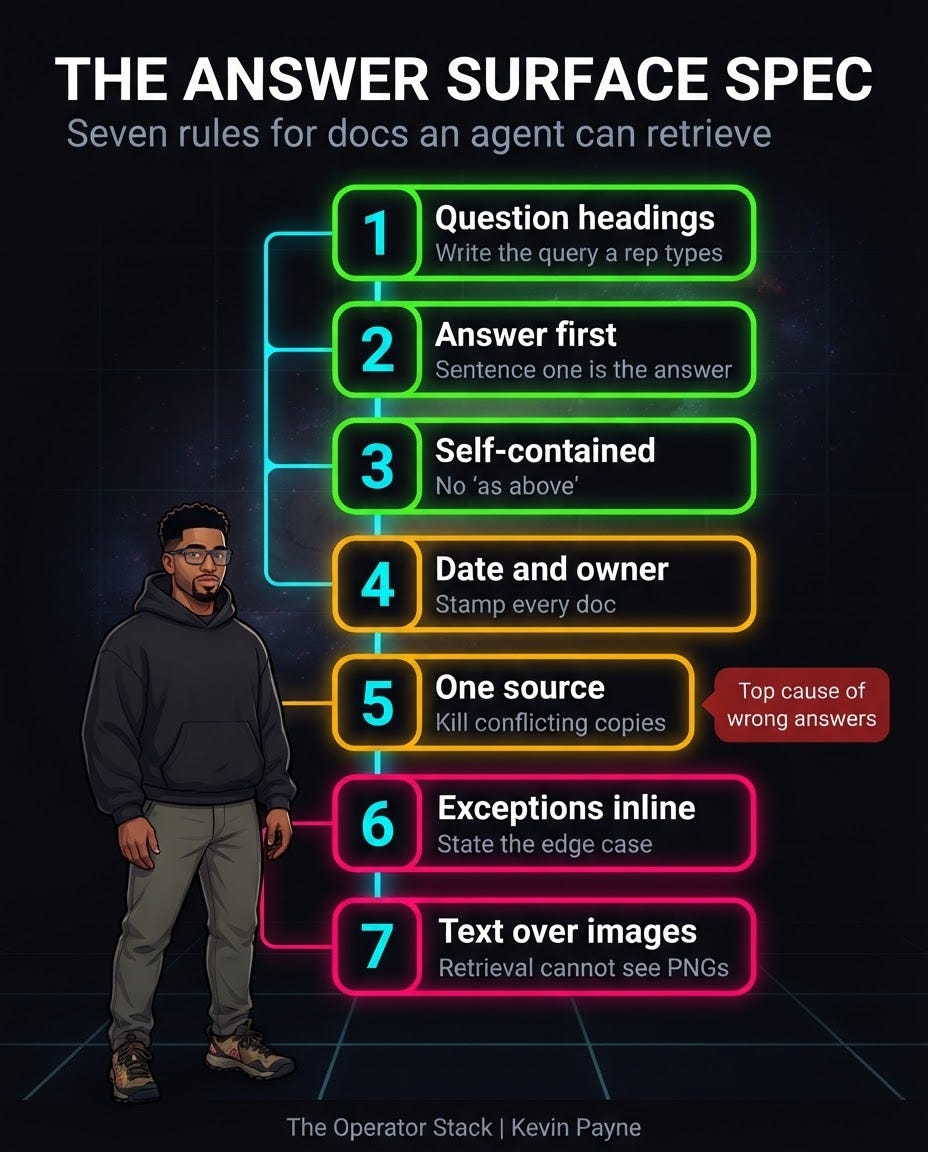
How do you write AI readable internal documentation for sales enablement? Write each doc so a retrieval system can lift any single section out, understand it without the rest of the page, and trust it. That means question-shaped headings, answer-first sentences, self-contained sections, date stamps with owners, one canonical source per answer, explicit exceptions, and text instead of screenshots. I call this set of rules The Answer Surface Spec.
The repeated-question tax is real
In his July 24 piece “Dumb Sales Questions,” Paul Stansik diagnosed a cost most GTM orgs pay quietly. Reps lose deals over things the rest of the company already knows. Nobody is careless. The knowledge exists somewhere, and the path from the question to the answer is too long, too social, or too unreliable.
Most teams treat this as a culture problem. Ask more in public, be nicer to people who ask, reward the people who answer. Those are fine instincts. They also treat the symptom.
The structural cause is that enablement docs were written for a reader who does not exist. The imagined reader opens the page, reads from the top, understands the context, and applies judgment about what is current. Real readers do none of that. They skim, search a keyword, jump to a heading, and copy the first plausible line.
That was survivable when the only readers were humans who could ask a follow-up. It stops being survivable when the reader is a machine that cannot.
The doc now has two readers
Here is what changed since Stansik’s diagnosis. The same doc is now read by two very different audiences.
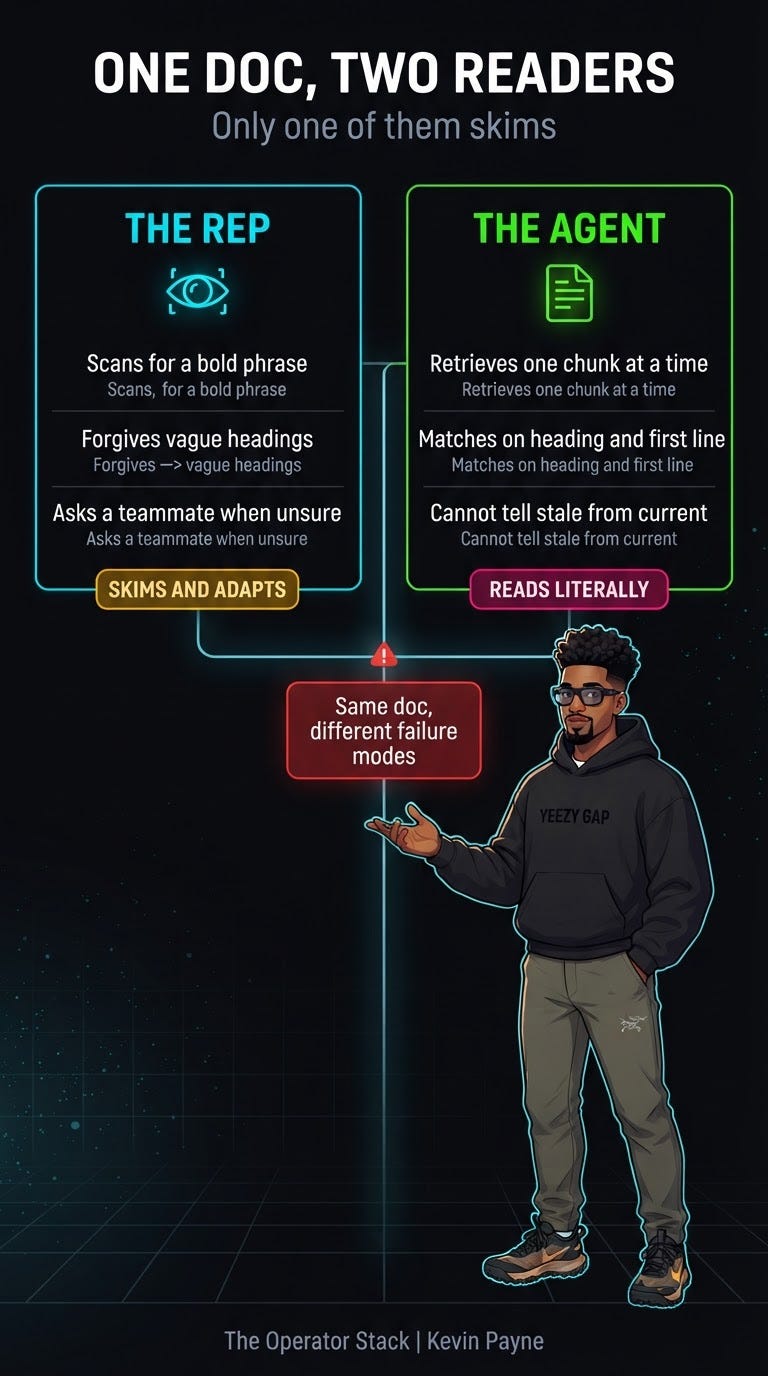
Reader one is the rep. They skim. They scan for a bolded phrase. They tolerate ambiguity because they can ping a teammate. They notice a stale date if it is visible, and they forgive a messy page if the answer is somewhere near the top.
Reader two is the agent. It does not read the page. It retrieves chunks of it. When it fetches a section, it usually does not know what came before or after that section. It weighs the words in the heading and the opening lines to decide whether the chunk matches the question. It cannot ask a colleague. It has no instinct that “this feels old.” If two chunks contradict each other, it picks one, and it sounds equally confident either way.
Only one of these readers skims. The other reads every retrieved word literally and treats all of it as true.
Darrell Alfonso’s August 24 push on MCP matters here because it shortens the timeline. When agents connect to internal knowledge through open protocols, they arrive in GTM orgs whether the docs are ready or not. Tools like Notion AI, Microsoft Copilot, and Claude Cowork can all pull from workspace content. None of them can fix a doc that was never structured to be retrieved. They can only surface the mess faster, and with more authority than a tired coworker in Slack.
Documentation quality used to be an annoyance. It is now the input quality for every agent you deploy on top of it.
Why the agent reads differently
Three behaviors explain almost every failure I see when agents answer from internal docs.
Chunking strips context. A retrieval system splits a page into pieces. A sentence like “as mentioned above, the standard terms apply” becomes meaningless when “above” is not in the piece. The agent has to guess what “the standard terms” means, and guessing is where wrong answers come from.
Semantic matching favors the heading and the first line. The system asks, in effect, “does this chunk look like an answer to this question?” A heading that says “Overview” matches nothing. A heading that says “Does the security addendum cover EU customer data?” matches exactly the question a rep will type.
Freshness is invisible without a stamp. A human might remember that the pricing page changed in spring. An agent sees two pricing chunks and no clock. Without a date and an owner, the older one wins as often as the newer one.
If you fix those three behaviors, you fix most of the problem.
The Answer Surface Spec
An answer surface is the part of a doc that a retrieval system can actually reach and use. The spec has seven rules. Each one is small. Together they change what a doc can do.
Rule 1: Write headings as the question a rep would ask
Replace “Pricing Overview” with “What discount can a rep offer without approval?” Replace “Security” with “Do we support single sign-on for customers on the starter plan?”
This one change does the most work. It matches how people query, and it matches how retrieval systems score relevance.
Rule 2: Answer in the first sentence
Put the answer, then the reasoning. “Yes, up to 10 percent, if the contract is under twelve months.” Then explain. A skimmer gets the answer in one glance. A retriever that only pulls the first lines still returns something correct.
Rule 3: Make every section self-contained
Ban “as above,” “see previous section,” “the same process,” and “this.” Name the thing every time. It feels repetitive to a human reader. To an agent, repetition is what makes a chunk usable alone.
Rule 4: Stamp every doc with a date and an owner
Put “Last verified: September 2026. Owner: RevOps” at the top of every doc, and again in any section that could stand alone. A date lets an agent prefer the newer chunk. An owner tells a human where to send a correction.
Rule 5: Keep one source for every answer that could conflict
This is the single-source rule. When two docs answer the same question, an agent will use both, and the reader will get whichever it retrieved first. Pick the canonical doc. Turn the others into a one-line pointer: “The current answer lives here.” Then delete the duplicated content, not just the link.
Rule 6: State the exceptions in the same section
“Standard payment terms are net 30, except for government customers, who receive net 60.” If the exception lives in a separate doc, the agent will answer the general case with total confidence and miss the case that matters.
Rule 7: Use text, not screenshots
A pricing table pasted as an image is invisible to retrieval. So is a flowchart saved as a picture and a slide exported as a PNG. Rebuild each one as a text table or a numbered list. Keep the image if you like it, but put the same information in text beside it.
These seven rules are also a checklist you can run against any existing doc in about ten minutes.
A before and after
Consider a composite example from a fractional engagement with a Series B client. This is illustrative, not a specific account.
Before:
Overview
As discussed, our standard terms apply. See the earlier section for the approval process. Contact Sam with questions.
Read this as a retriever. “Standard terms” is undefined. The “earlier section” is not in the chunk. “Sam” has no last name and may have left the company. There is no date. The chunk matches almost no real question.
After:
What discount can a rep offer without approval?
Last verified: September 2026. Owner: RevOps.
A rep can offer up to 10 percent on contracts of twelve months or less without approval. Discounts above 10 percent require sign-off from the VP of Sales. Multi-year contracts follow a separate approval path, described in “Who approves multi-year discounts?” Exception: partner-sourced deals follow the partner pricing sheet instead.
Same information, plus two details the original hid. Now a rep can skim it in two seconds, and an agent can lift it into an answer without losing anything.
How to implement this in one week
Do not rewrite everything. Rewrite what gets asked.
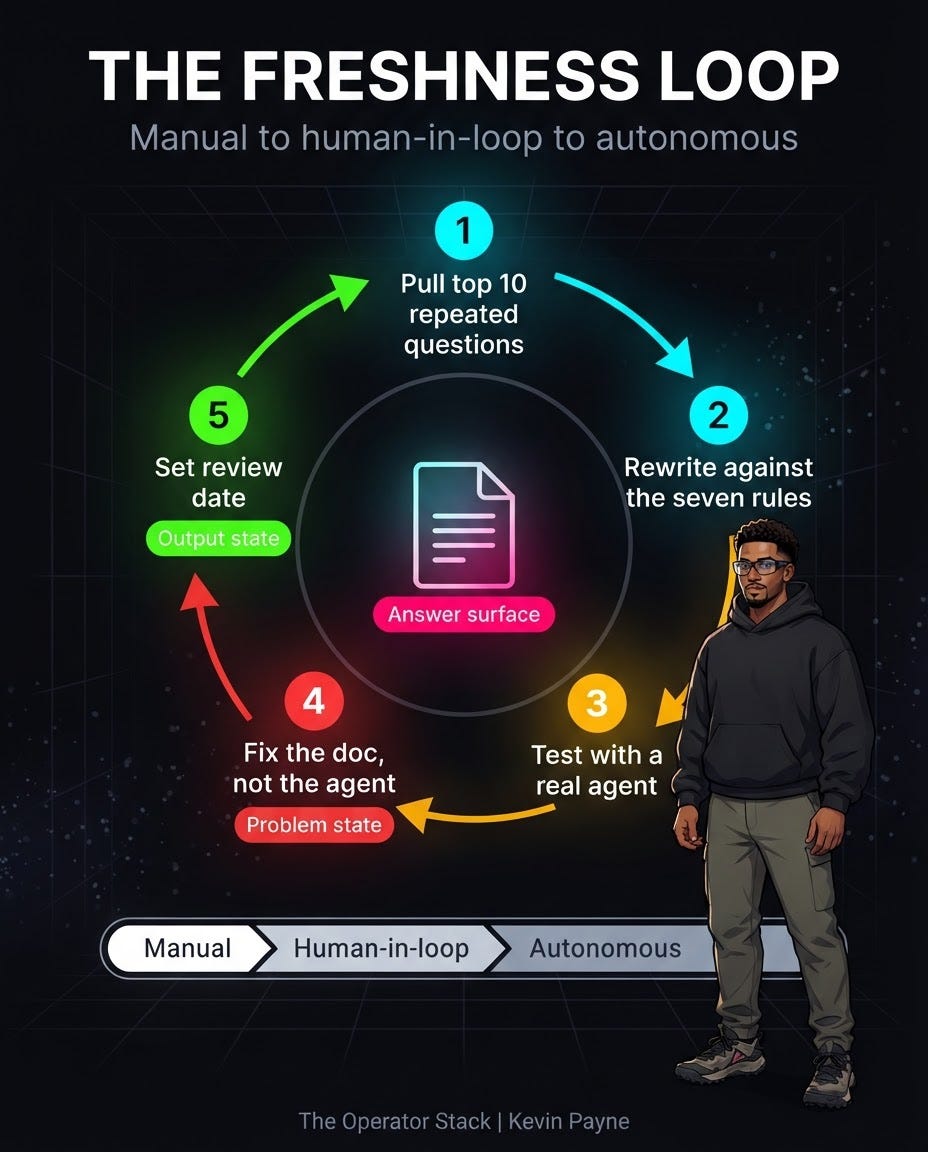
Step 1 (20 minutes): Pull the top ten repeated questions. Use Slack search, call recordings, or a simple list from your team. These are the questions Stansik’s “Dumb Sales Questions” describes. They are your first answer surfaces.
Step 2 (30 minutes): Find the source doc for each. If you find more than one, apply Rule 5 and pick a canonical version. If you find none, write one.
Step 3 (30 minutes per doc): Rewrite against the seven rules. Batch them. Do three docs in a sitting, not ten.
Step 4 (15 minutes): Test with a real agent. Ask the ten questions in Notion AI, Microsoft Copilot, or Claude Cowork, whichever your team uses. Compare each answer to what you wrote. Where the agent gets it wrong, the doc is the problem, not the agent. Fix the doc and ask again.
Step 5 (10 minutes): Set a review date. Put it on a calendar. An answer surface that is not maintained becomes a confident source of wrong answers.
Start with step one, today, with a timer set for twenty minutes.
Move from manual to human-in-loop, not straight to autonomous
I use the same progression for every AI workflow: manual, then human-in-loop, then fully autonomous. Documentation follows the same path.
Manual: a person answers the question, and the doc exists as backup.
Human-in-loop: an agent drafts the answer from the doc, and a person confirms it before it reaches the rep.
Autonomous: the agent answers directly, and the team reviews a sample each week.
Do not skip a stage. If the agent’s draft answers keep needing correction, the doc has not earned autonomy yet. That is useful information. It tells you exactly which sections to fix.
Why this is a stewardship question
I think about documentation as stewardship. A team’s shared knowledge is a resource entrusted to everyone who works there. When it is scattered, contradictory, or stale, the cost lands on the newest person and the busiest person, who then have to pay the tax of asking. Writing a clear answer once, and maintaining it, is a quiet way to serve everyone who comes after you.
The arrival of agents raises the stakes. A confusing doc used to cost a rep ten minutes. A confusing doc read by an agent can cost a deal, and no one will see it happen.
What to do this week
The doc is now written for two readers. One skims and forgives. The other retrieves and believes. You can serve both if you write for the second and format for the first.
Pick one question your team asks repeatedly. Rewrite the doc that answers it using the seven rules. Then ask an agent the same question and see what comes back.
I am curious which doc you would rewrite first. Reply and tell me the question your team asks most often. I read every response.