


If you are a busy operator and AI still feels like a productivity hack rather than a leverage system, this is for you.
I am not going to tell you to use more tools. I am going to tell you to use your tools differently.
Here is what I see constantly inside operator communities, RevOps teams, and GTM functions: talented people stacking subscriptions without ever building the connective tissue between them. They are using AI like a slightly smarter search engine. And then wondering why their output is not 3x.
The problem is not the tools. It is the mental model.
In a Series A SaaS operator role, I started mapping every workflow I was building against a single question: what kind of leverage is this actually creating? What I found was that all high-leverage AI work falls into one of four categories. I started calling them powers because each one compounds differently, and most operators are only using one or two of them consistently.
This is the 4-Power Operator Stack. It is the framework I use to audit my own productivity, plan my week, and teach other operators how to close the gap between how they are using AI and how they could be using it.
Let’s go through all four.
The 4-Power Operator Stack
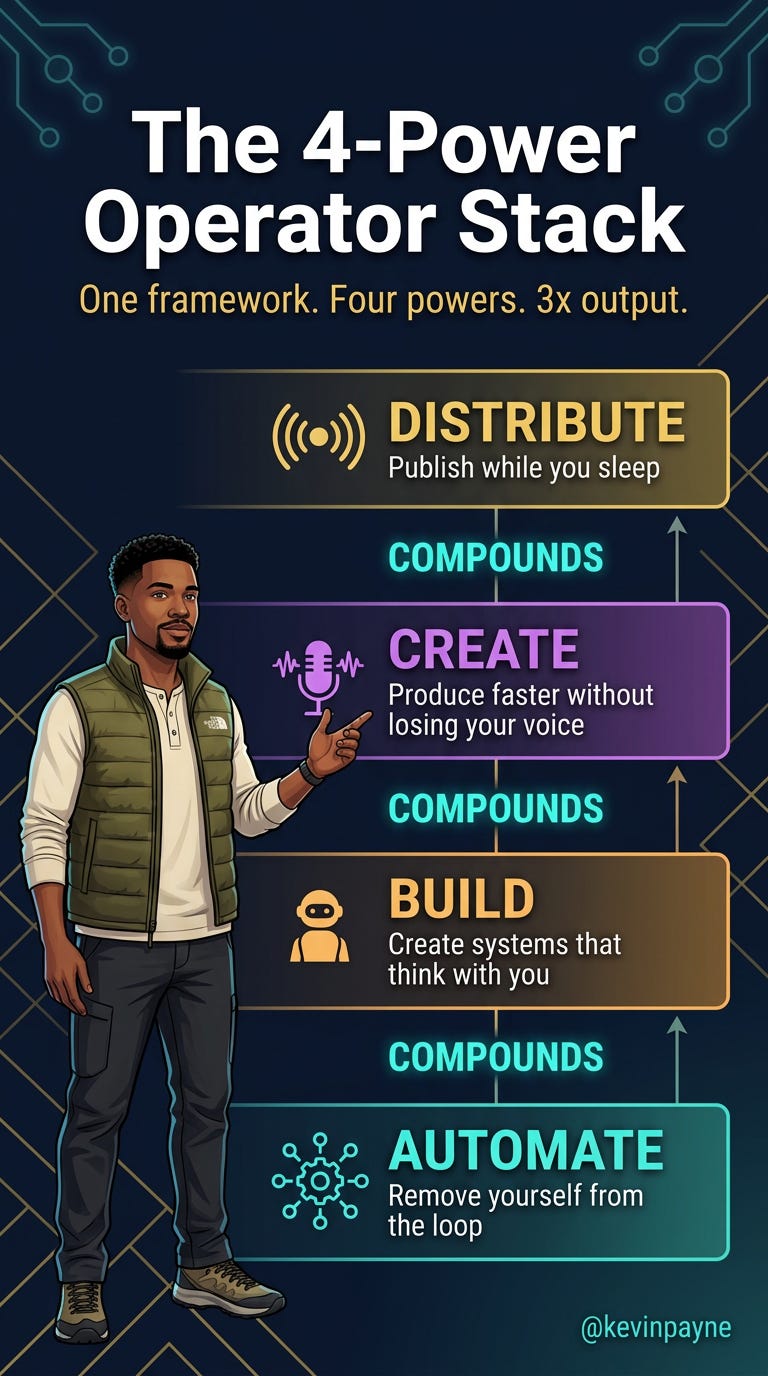
Power 1: Automate — Remove Yourself from the Loop
Definition: You build a rule-based workflow that runs without you. No human decision-making required, no manual trigger, no copy-paste.
Automation is the most understood power and the most underused in its full form. Most operators set up one or two notifications, feel good about it, and stop. That is not automation at scale. That is triage.
Real automation means you identify every recurring, rule-based task in your workflow and systematically remove yourself from it.
In a Series A SaaS operator role, the first place I looked was lead routing. Intent signals were firing in 6sense and being manually reviewed each morning before reaching the right rep. That is a human doing a routing job. I rebuilt it so the signal fires at a defined threshold, the account routes to the correct rep in Salesforce, a targeted sequence launches automatically in Outreach, and the rep receives a context-loaded notification. Zero manual touches from signal to sequence.
That is one hour of daily manual work eliminated permanently. Not reduced. Eliminated.
The Automation Audit: Walk through your last five workdays. Write down every task you did more than twice. Every one of those is a candidate. Anything that follows a rule should not require you.
✦ Quick win this week: Build one automated alert that fires when a high-value signal triggers in your CRM or intent platform. Test it once, then let it run. The goal is a single workflow you never touch again.
Tools: Salesforce, 6sense, Qualified, Outreach
Power 2: Build — Create Intelligent Systems That Think With You
Definition: You build a functional AI system, whether an agent, assistant, or structured workflow with embedded intelligence, that did not exist before.
This is where most operators stall because it requires a mental shift. Automation follows rules. Building creates judgment. The difference is not the tool. It is the output.
When you build a custom Claude project that knows your ICP backwards and qualifies inbound leads in 30 seconds, that is a built system. When you configure a Qualified bot that scores and routes site visitors based on your own scoring logic, that is a built system. When you build a Notion database where AI workflows auto-populate competitive context the moment you add a new prospect, that is a built system.
The operator instinct here is to wait until you understand the tool deeply before building. Flip that. Build something that works at 70%, then iterate. The 30% gap teaches you faster than any tutorial can.
✦ Quick win this week: Open Claude and create a new Project. Write a system prompt that describes your ICP in detail: company size, tech stack signals, pain points, disqualifiers. Paste a raw inbound lead or LinkedIn profile. Ask it to score and qualify. You have just built a lightweight qualifier.
Tools: Claude, Notion, Qualified, Salesforce
Power 3: Create — Produce Faster Than Your Competition Without Losing Your Voice
Definition: You use AI to collapse the time between a thought and a published asset, without letting AI replace your perspective.
Creating is not just for content people. Every operator is producing: SOPs, internal memos, Slack updates, Salesforce notes, strategy decks, email sequences. The question is whether you are producing at the rate your role demands.
My personal workflow starts with Superwhisper. When I observe something worth documenting, whether a workflow that worked, a customer insight, or a framework forming in my head, I hit the global hotkey and speak for three to five minutes without thinking about structure. Raw audio becomes a transcript. The transcript goes into Claude with a brief prompt. The output is a structured first draft I refine in 15 minutes.
What used to take two hours now takes 20 minutes. And because the seed of every piece is my lived experience, the voice stays mine.
The operators who are building portfolio careers in 2026 are not writing more. They are capturing their thinking more efficiently and using AI to structure what was already there.
✦ Quick win this week: Voice note one thing you learned or implemented this week using Superwhisper or your phone’s voice memo app. Drop the transcript into Claude with this prompt: “Turn this into a structured LinkedIn post draft. Keep my voice, direct, practical, no fluff.” See what comes back.
Tools: Superwhisper, Claude, Notion
Power 4: Distribute — Systematize Your Reach So You Publish While You Sleep
Definition: You take every created asset and systematically amplify it across platforms and formats without manually posting anything.
Creating without distributing is the most common bottleneck I see in operator-creators. They write something strong, post it once, and move on. Or worse: they write something strong, do not know where to put it, and it sits in a Notion doc for three months.
Distribution done right means your content has a scheduled home before you write it. Every piece I produce goes into a Typefully queue. The thread publishes at 2:00 AM PT. The LinkedIn version goes at 8:00 AM. Five daily X posts are staggered across the day. The Substack draft is staged and ready. All of that is scheduled before I close my laptop on batch day.
The operational principle here: your distribution system should be more reliable than your motivation. There will be weeks where energy is low. The system publishes anyway.
For operators who are early in building a public presence, Power 4 can feel premature. It is not. The best time to build a distribution system is before you have an audience, so that when the audience comes, the flywheel is already turning.
✦ Quick win this week: Sign up for Typefully and schedule one post for next week. Then schedule another one for the week after. You now have a queue. That is a distribution system in its earliest form.
Tools: Typefully, Substack, LinkedIn, X, Threads, Bluesky
The Monetization Loop: How Operator Work Becomes Portfolio Income
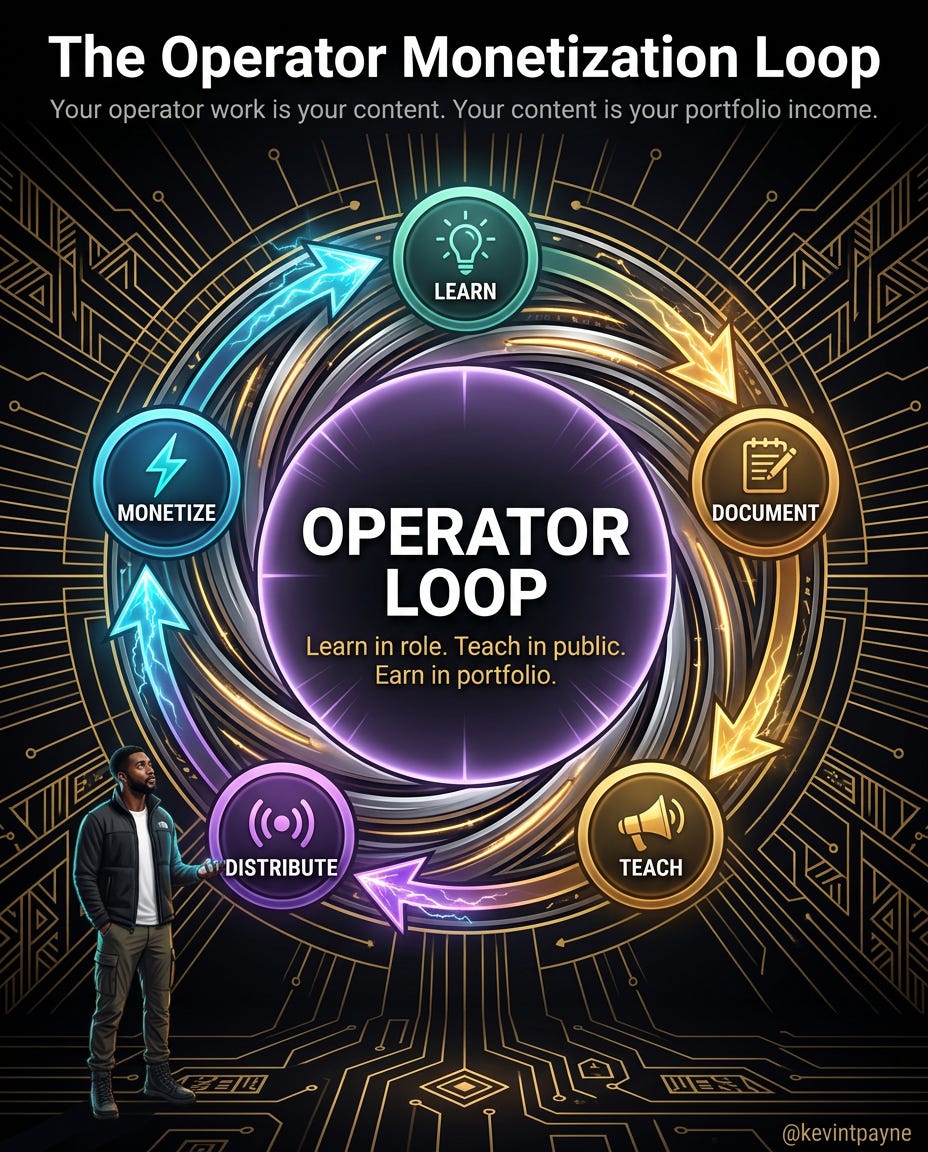
This is what connects the four powers into something bigger than productivity.
Most operators think of AI as a way to do their job faster. That is correct but incomplete. The 3x operators I have studied are using the stack to run a second track in parallel with their operator role.
Here is how the loop works:
Step 1: Learn (Operator Role). You do real work. You build systems, navigate constraints, document what breaks, and accumulate pattern recognition that nobody can replicate from a tutorial.
Step 2: Document (Power 3). You capture that learning, not in an internal wiki nobody reads, but in a format designed for a public audience. A framework. A short case study. A hard-won lesson. Anonymized, employment-safe, genuinely useful.
Step 3: Teach (Substack). You publish the framework. The newsletter is your canonical asset. It is SEO-indexed, owned, and evergreen. Every post adds a brick to a body of work that compounds over time.
Step 4: Distribute (Power 4). The newsletter becomes a thread, a LinkedIn post, a YouTube walkthrough, a Gamma deck. Five formats, one idea. The distribution system carries it.
Step 5: Monetize (Portfolio Income). The audience you build from teaching becomes the source of advisory relationships, consulting engagements, a paid newsletter tier, a community, a course. Each is a stream. Three streams is a portfolio.
I want to be clear about one thing: this loop does not require you to go viral. It requires consistency and specificity. The operators who are monetizing their knowledge in 2026 are not the loudest ones. They are the ones whose content is the most operationally credible because it comes from doing the work first.
How to Pick One Power to Focus on This Month
Before you try to level up all four, pick one. Here is how.
Ask yourself these four questions:
1. What is your biggest time leak right now? If you are spending hours on tasks that follow clear rules, start with Automate.
2. What capability do you wish you had but do not? If there is a research, qualification, or synthesis task that takes too long, start with Build.
3. Do you have insight that is not being shared? If you are learning things in your role that others would pay to know, start with Create.
4. Is your content dying in drafts? If you are creating but not reaching people consistently, start with Distribute.
One power, one month, one compounding win. Stack them in sequence once each one has become a habit.
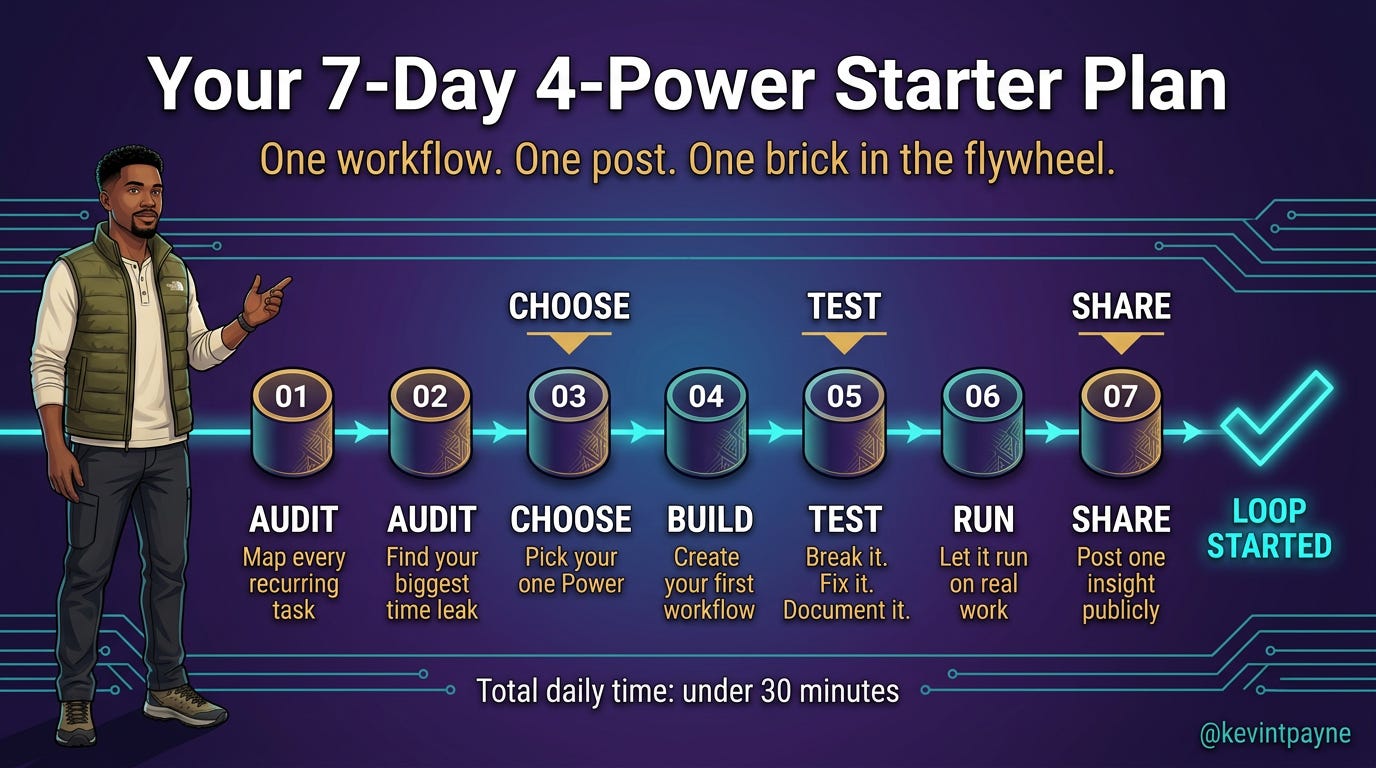
The 7-Day Starter Plan
This is designed to be completed in under 30 minutes per day. No heroics required.
Day 01: Audit. List every recurring task from your last workweek and note which Power could reduce your time on each one. You are not building anything yet. Just seeing clearly.
Day 02: Audit (continued). Identify your single biggest time leak. The answer to that question determines which Power you start with.
Day 03: Choose. Pick your Power. Write down one specific win you want to achieve with it this month.
Day 04: Build. Keep it small. One automation, one Claude project, one Superwhisper capture, one scheduled post. A working prototype by end of day.
Day 05: Test. Run the workflow. Break it deliberately. Fix what breaks. Write two sentences about what it does and why it matters. That documentation will become content later.
Day 06: Run it live. Let the workflow operate on real work. You are observing, not maintaining.
Day 07: Share. Post one insight you learned this week on LinkedIn or X. It does not have to be polished. It has to be real. This is the first brick in your Learn, Create, Distribute loop.
What I Have Learned After Building Across All Four
The 4-Power Operator Stack is not a tool list. It is a thinking framework. The tools change. The powers do not.
What changes when you internalize it is how you evaluate new tools and new work. Before picking up any new AI product, I ask: which power does this strengthen? If it does not clearly fit a power, or if that power is not the one I am developing right now, I pass.
And when I am overwhelmed by my task list, I ask: which of these tasks should I automate, build a system for, capture and turn into content, or distribute more systematically? That question alone has been worth thousands of hours.
The operators who are going to win the next five years are not the fastest adopters. They are the ones building AI into how they think and then building frameworks that help others do the same.
I believe you are reading this because you are one of them.
If this landed, forward it to one operator in your network who is still using AI like a chatbot. They will thank you later.
Kevin Payne writes about AI operations, GTM engineering, and building a portfolio career from inside an operator role. Subscribe to receive frameworks and playbooks.
Amazing practical guide!