

There is a very specific silence that happens about ten days after an agent goes live.
The build worked. The demo landed. Somebody screenshotted the workflow diagram and posted it in the team channel with three fire emojis. And then a lead came through that the agent handled in a way nobody expected, and a rep saw it, and instead of flagging it, that rep quietly stopped trusting the queue. Two weeks later the agent is technically still running and functionally abandoned.
I have watched this pattern often enough now to stop blaming the model.
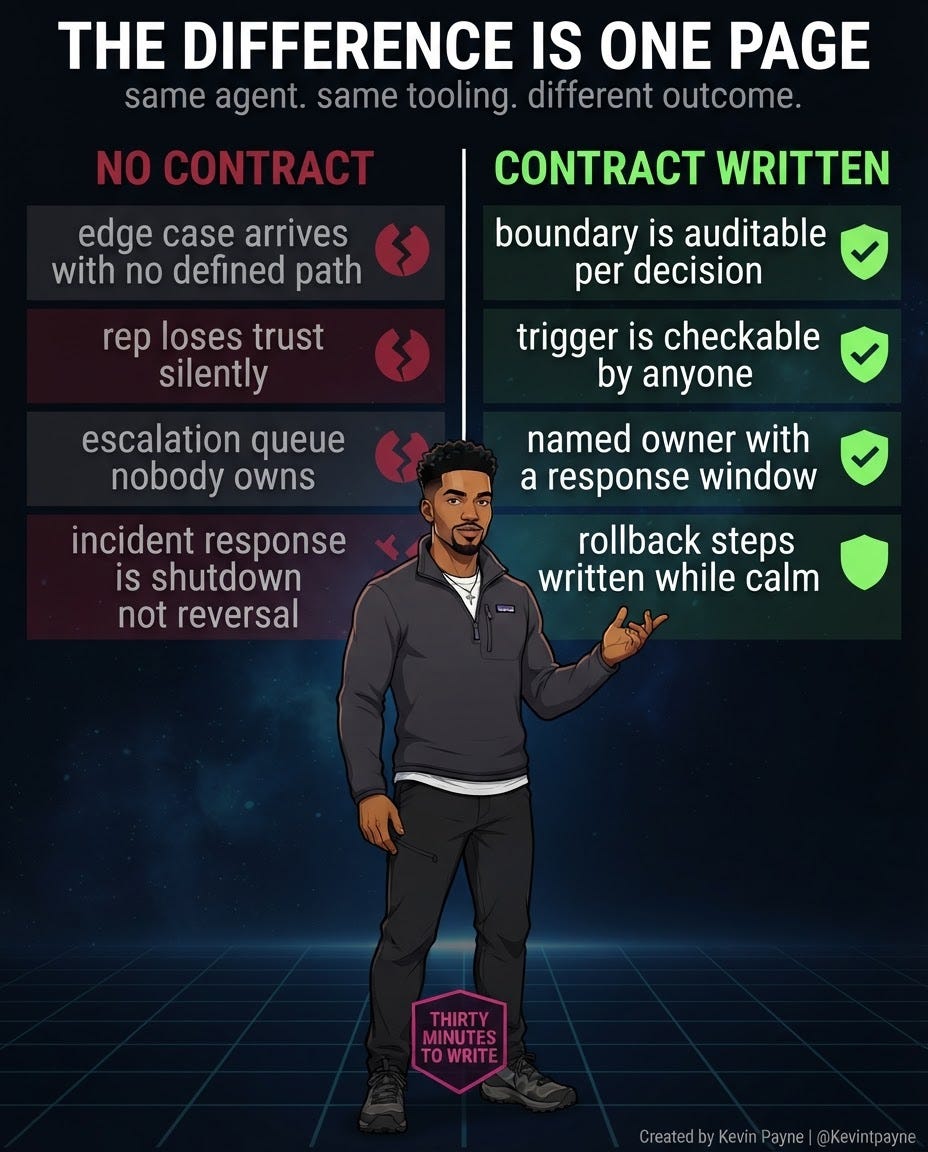
The failure is not that the agent made a bad call. Agents make bad calls, the same way new hires make bad calls. The failure is that nobody had written down, before launch, what the agent was allowed to decide on its own, what it was required to escalate, and who was responsible for answering when it escalated. There was no artifact. So when the edge case arrived, the resolution path was improvisation, and improvisation does not scale past one incident.
That artifact has a name in every other operational discipline. In legal it is a delegation of authority. In finance it is an approval matrix. In manufacturing it is an andon protocol. In AI operations it does not exist yet, which is strange, because agent deployments need it more than any of those.
The reason it needs it more is that an agent produces output at a volume and speed no human reviewer naturally keeps up with, and it produces that output with a uniform confidence that reads, to everyone downstream, as certainty. A junior analyst who is unsure sounds unsure. An agent that is unsure sounds exactly like an agent that is correct. So the ordinary social signals a team uses to calibrate trust are simply absent, and the only thing that can replace them is a written boundary agreed to in advance.
I call it the Agent Handoff Contract.
Why the setup guide is not the problem
I want to be careful here, because it would be easy to read this as a swipe at the setup guide format, and it is not.
Setup walkthroughs are the dominant content format in this space right now, and they deserve to be. The guides coming out of the Claude Cowork community over the summer are genuinely good work. They take somebody from zero to a running configuration in under an hour, which is a real service, and the volume of them reflects real demand. Same with the vendor documentation. Qualified will walk you through standing up an inbound AI SDR. Outreach will walk you through sequencing logic and agent-assisted execution. The tooling documentation is not thin.
The guides are not wrong. They are just complete for a different question than the one operators are actually holding.
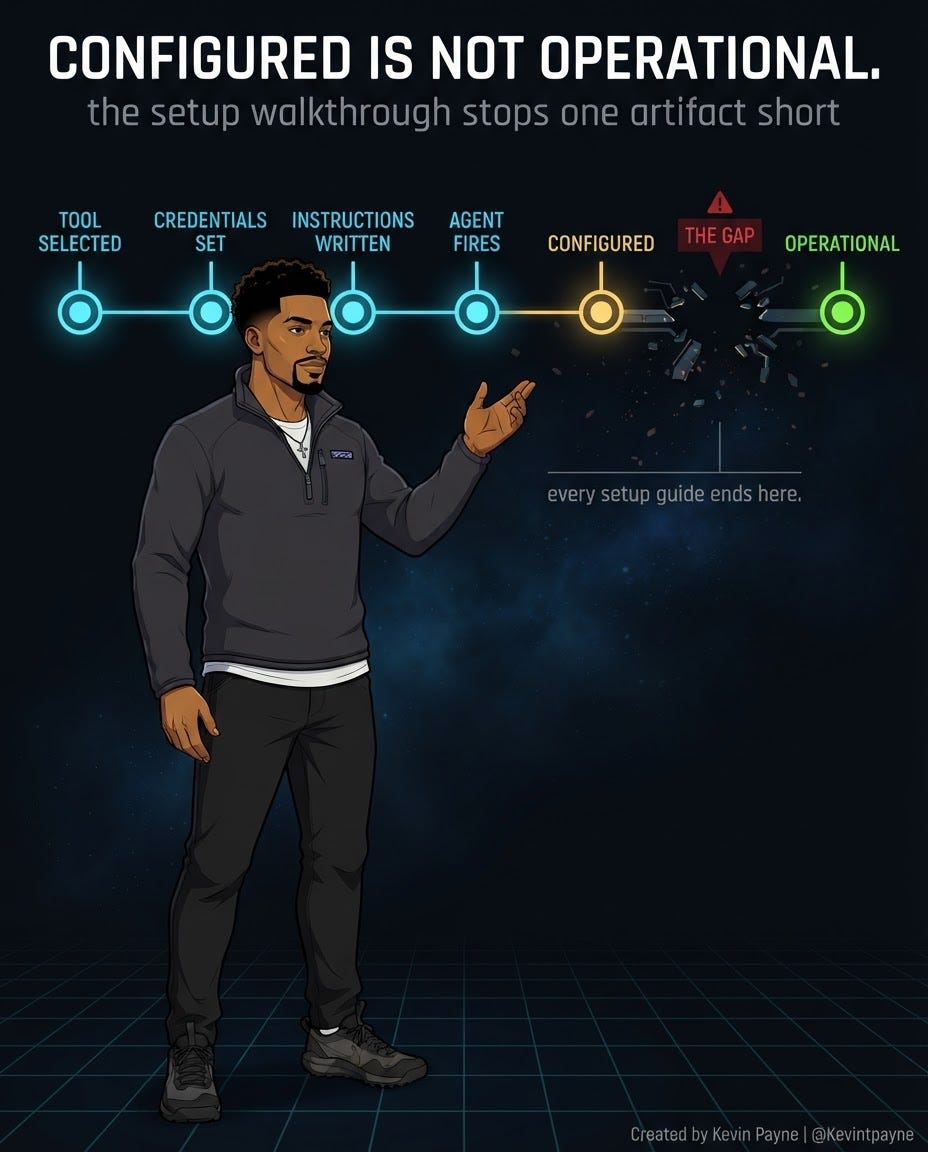
Every one of them terminates at the same state: configured. The agent has credentials, it has instructions, it has a trigger, it fires. That is a real milestone and it is worth celebrating.
But configured is not operational.
Operational means the agent runs inside a system of accountability where humans know what to expect from it, know when they are on the hook, and know what to do when it produces something wrong. Operational means a rep who disagrees with an agent decision has a defined path that is not “complain in Slack.” Operational means when something breaks at scale, you can reconstruct who owned what.
The distance between configured and operational is where most implementations stall. And it is a documentation gap, not a tooling gap. No new model release closes it. No better prompt closes it. You close it by writing something down before you launch.
The Agent Handoff Contract
The contract is one page. It is not a policy document, it is not a governance framework, and it should not require legal review. If it takes more than thirty minutes to write, you are overbuilding it.
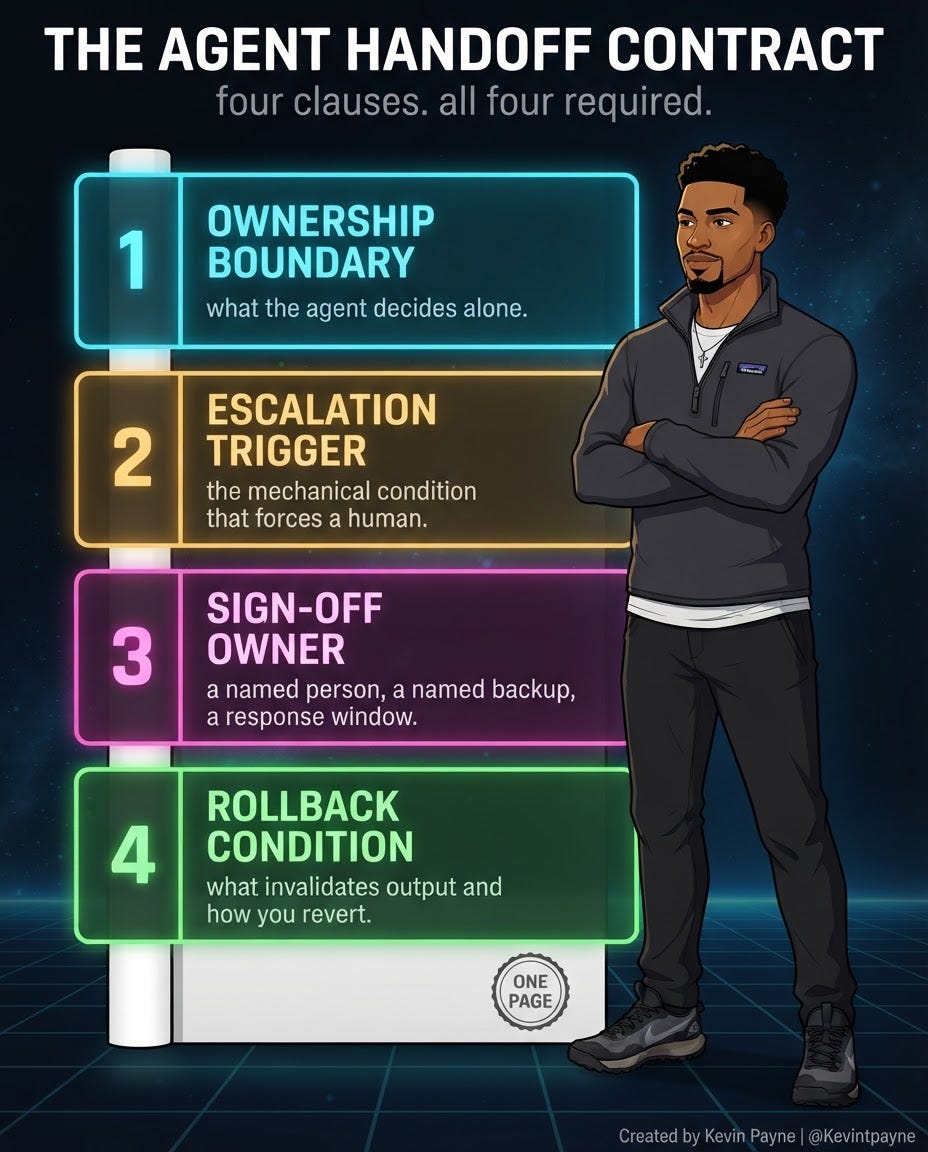
It has four clauses. All four are required. A contract with three clauses fails in production, and I will show you exactly how at the end.
Clause 1: Ownership boundary. What does the agent own outright, with no human review, ever?
This is the clause people get wrong most often, because they write it as a capability statement instead of an authority statement. “The agent qualifies inbound leads” is a capability. “The agent assigns a lead score and routes to the correct territory queue without review” is an authority. The difference matters, because the second version is falsifiable. You can look at a specific action and say whether it fell inside the boundary.
Write this clause as a list of decisions, not a list of functions. Three to five decisions is typical. If your list runs past eight, you are describing a system, not an agent, and you need more than one contract.
Clause 2: Escalation trigger. What condition forces a human into the loop?
The trigger must be mechanical. Not “when the agent is uncertain,” because uncertainty is not observable from outside the model and you cannot audit against it. Mechanical means a condition an outside observer can evaluate without asking anyone’s opinion. Deal value above a threshold. Account already in an open opportunity. Contact title matching a named list. Confidence score below a set number, if your system exposes one and you have calibrated it.
The test I use: could a new hire, reading only this line, tell me whether a given case should have escalated? If the answer is no, rewrite it.
Clause 3: Sign-off owner. Who resolves the escalation, by name and role?
Not a team. Not a queue. A person, with a named backup, and a response window.
This clause is the one that gets removed for political reasons, and removing it is what kills the whole thing. Escalation paths that point at a group do not get answered, because in a group of five nobody is the one who dropped it. I have seen an escalation queue with a two hundred item backlog where every single person believed somebody else was working it. The agent had been correctly flagging edge cases for eleven weeks. It was doing its job perfectly. The contract clause it depended on had been softened from a name to a team.
Clause 4: Rollback condition. What invalidates the agent’s output, and how do you revert?
This is the clause nobody writes, and it is the reason “we turned it off” is the standard incident response in this category.
Rollback is not the same as shutdown. Shutdown stops future harm. Rollback undoes existing harm. If an agent has been mis-scoring leads for six days, turning it off does nothing about the six days of bad routing already sitting in your pipeline. The clause needs to define both the condition that triggers a reversal and the mechanical steps to execute it. Which records get reset. Who reassigns them. What the humans downstream are told.
Write this clause while you are calm. You will not write it well during the incident.
Implementation
Here is how to actually produce one, in a single sitting.
Step one, list the decisions. Open a blank page and write every decision the agent makes in a normal run. Not tasks, decisions. Points where an outcome branches. Most agents that look complicated make between four and nine actual decisions, and seeing them listed is usually the first clarifying moment.
Step two, sort into three buckets. Agent owns. Agent recommends, human confirms. Human owns, agent assists. Be honest in this step rather than aspirational. First-version contracts should be conservative. You can widen the ownership boundary later once you have evidence, and widening is a much easier conversation than narrowing after an incident.
Step three, write the trigger for each boundary crossing. For every decision in the middle bucket, write the mechanical condition. Apply the new-hire test.
Step four, name the owner. Get the name. Get the backup name. Get the response window in hours. Then, and this is the part that makes it a contract rather than a document, send it to that person and get an acknowledgment. A sign-off clause the sign-off owner has never read is decoration.
Step five, write the rollback. Condition, steps, comms.
I draft these in Claude Cowork now, because the whole thing is a structured document produced from a messy transcript of me talking through the workflow, which is exactly the shape of task that mode is good at. Twenty minutes of voice capture, one pass to structure, one pass to sharpen the triggers. The tool is not the point though. A shared doc and thirty focused minutes gets you the same artifact.
Step six, version it. Date it. Every material change to what the agent owns gets a new version. This is the part that turns the contract into an audit trail, and the audit trail is what you will want the first time somebody senior asks how a decision got made.
What it looks like in practice
Take an inbound qualification agent, the most common first deployment in this category.
Ownership boundary. The agent scores inbound form fills against fit criteria, enriches contact data, assigns territory, and routes to the owning rep’s queue. It sends the first templated response. It does not modify opportunity stage, it does not set close dates, and it does not contact anyone at an account with an open opportunity.
Escalation trigger. Any inbound where the account has an open opportunity, any contact with a title on the executive list, any account flagged as strategic, and any form fill with an annual contract value estimate above fifty thousand dollars. Each of those is checkable by anyone with read access.
Sign-off owner. The inbound demand manager, by name, backed up by the RevOps lead, four business hour response window during the working day.
Rollback condition. If scoring accuracy against manual review drops below a set threshold on any weekly sample, routing reverts to the previous rules-based logic, all leads from the affected window get re-queued for manual review, and the owning reps get a direct note explaining what happened and what was corrected.
That is one page. That is the entire artifact. And it is the difference between an agent that survives its first bad week and one that gets quietly abandoned.
Now go back to the story I opened with. Which clause was missing? Not the ownership boundary, that one was clear. Not the trigger. The rep who saw the odd output had nowhere defined to send it and no expectation that sending it would produce a response. Clause three. And because clause three was missing, clause four never fired, because nobody with authority ever learned there was a problem to reverse.
Three clauses is not a contract. It is a hope.
The part that is actually about trust
I will say the quiet thing.
Most resistance to writing a handoff contract is not about process overhead. It is that the contract forces you to state, in writing, how much you actually trust the system you just built. That is uncomfortable, especially when you were the one who championed it, and especially when the honest first-version answer is “less than I implied in the demo.”
But that discomfort is the whole value. A contract that makes you wince is doing its job. The alternative is discovering the real boundary during an incident, in front of people who did not agree to the risk you took on their behalf.
This is stewardship, plainly. You are asking colleagues to trust a system they did not build and cannot inspect. Writing down what it owns and who answers for it is the minimum honest thing to do before you ask for that trust.
The setup guide gets you to configured. The contract gets you to operational. Write the page.
I write about the systems layer of AI operations: what happens after the tool is configured and before it actually works. New issue every week.
Word count target check: run wc -w on body section before publishing.